Showing posts with label Reviews. Show all posts

Thursday, December 20, 2012

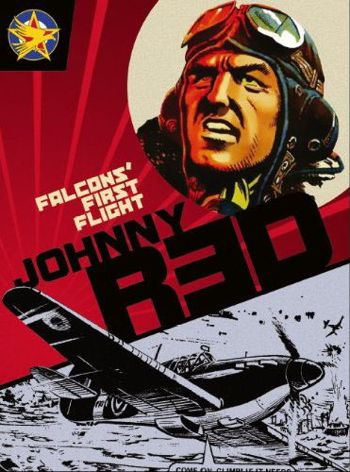
Johnny Red: Falcons’ First Flight

The most recent installment in Titan’s series of hardcover reprints of late ’70s British war comics, Johnny Red breaks the mold that the last seven years’ worth of Charley’s Warreprints have been building; unlike that series, Falcons’ First Flight isn’t concerned with educations in class warfare or war-is-hell parables. Pure excitement is the primary concern, and while artist Joe Colquhoun’s taste for accurately referenced machinery keeps Johnny Red sternly connected to visual realism, writer Tom Tully never met a cliché he was unwilling to pluck. (Does Johnny refer to himself in third-person on occasion? Of course he does! Does our hero cry upon receipt of the Order of Lenin? Even Stalin had less manly tears.)


Of course, the format shouldn’t go without mention—these stories were originally serialized in three-page weekly onslaughts over the course of five years, and any desire on the part of Tully to change things up a bit would’ve been sorely tested by the limitations inherent to that kind of turn-it-in schedule. Without the sort of political agenda that motivated Charley’s War (to say nothing of the range of stories that could be told in that title, seeing as its main character continually traversed most of World War I’s European terrain), Tully’s options at the beginning of these stories are relatively limited. See, Johnny’s a young British pilot, dishonorably discharged for striking an officer before he could even go to war (in the early pages of the series, the officer survives the ensuing fall, but by the middle of this volume, the back-story is changed to depict him as having died, thus making Johnny an accidental murderer with no legal hope of ever flying for the RAF). Due to some circumstances best described on the book’s hysterical back clover blurb, Johnny ends up stealing a high end British fighter plane (a Hurricane) and joining the surviving members of the Falcons, a down-on-their-luck squadron of Russian fighter pilots. He can’t go home, but at this point in the story, defection is still out of the question. There’s only one real option: non-stop fighting. (Or, as Garth Ennis puts it in his justly hyperbolic introduction, “total war”.)


Johnny’s basic situation is a great narrative idea, no matter how illogical it might sound, and seeing the character go from idealized mascot to sideways leader of the Falcons contains no small measure of excitement. On the visual front, there’s plenty of examples demonstrating why Colquhoun’s death would later shutter Charley’s War, with his depictions of air combat here a constant delivery of the dense, hyper-detailed carnage that made all of his war comics so popular and engaging. That isn’t to say that everything about them is particularly easy to read—like the Charley’s War reprints, there’s a good ten pages of poorly scanned material—but for the general war comic fan, the effort to keep up is undoubtedly going to be part of the enjoyment. (Ultimately, the density of each panel comes as a direct result of Colquhoun’s consuming interest in accurate depiction, which apparently overrode concern over whether this made it difficult for the lay reader to immediately distinguish certain types of historic warplanes from one another.)


Johnny Red isn’t an acquired taste, but it is a predetermined one—people are either down for this kind of stuff, or they aren’t. While not devoid of the sentiment that can disease the war films it most resembles, it is more firmly grounded in that sentiment’s home: patriotic, full-of-shit hearts, gutter drunk on idealized brotherhood and the religion of dumb luck. Johnny’s adventures are ones where every motive (both the readers and the characters) is laid out in full display. There’s nothing to get in the way of guns, glory, and the freedom of the one man war. Its pleasures are, to some extent, juvenile (comic’s standby synonym for the word “intoxicating”), but that’s to be expected, if not welcomed. Johnny doesn’t want to teach you about morality, and like the dopey Labrador his Russkie comrades often resemble, it’s laughable to think he even could. It’ll be up to the individual in which column to chalk up this absence of morality; be it a shrugged out win, or a stormed off loss.

The Infinite Wait And Other Stories

In a sense, the heart of each of the three short stories in Julia Wertz’s memoir The Infinite Wait is the impact that discovering comics has had on her life. Ostensibly, the book is broken up into “Industry”, a chronological account of her life as seen through her job history; “The Infinite Wait”, her account of learning that she suffered from chronic systemic lupus; and “A Strange and Curious Place”, a love letter to the first public library she haunted as a child. While each story can be read as discrete narratives, the truth is that this book is a sort of recapitulation and revisitation of the themes and events she explored in her first three books (The Fart Party Volumes 1 & 2; Drinking At The Movies). There’s a deeper level of narrative, thematic and emotional complexity that becomes more apparent as one reads the book for a second time. Wertz doesn’t exactly disown her earlier works in this book, but she goes into detail as to why each of them make her uncomfortable from her current perspective.

In the interest of full disclosure, I blurbed the book. I wrote, “Julia Wertz has become one of the most bracingly raw and honest autobiographical cartoonists without losing an ounce of her irreverent, silly, profane and scathing sense of humor.” That latter point must be emphasized: though Wertz takes on some serious topics and reveals some harsh truths about herself in the course of the book, her sense of comic timing has never been better. While each story does have a roughly chronological narrative structure, Wertz rambles, goes on tangents, and diverges into events and themes that aren’t directly related to the ostensible subject of each chapter. The result is a book that’s all over the place in the best possible sense, as her divergences and references to past books and past events, as well as the way she retells certain events from a different point of view, speak to the complicated, messy way life is lived and experienced.
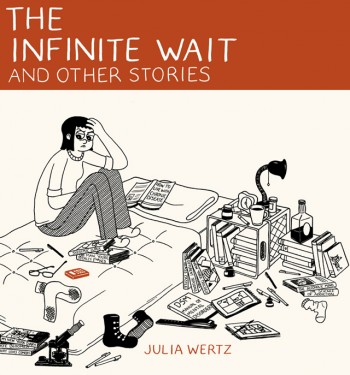
The cover of the book offers a number of clues to the reader as to what should be expected. A scowling Wertz is sitting on her bed but is nonetheless surrounded by things that are important to her: pens, ink, paper, comics (including the three that were name-checked as big early influences: Julie Doucet’s My New York Diary, Ivan Brunetti’s Misery Loves Comedy, and Carol Tyler’s Late Bloomer), a bottle of whiskey, books about alcoholism and addiction, books about mental illness, books about lupus (including one “titled” Oh Man You’re Totally Fucked) and several other books that have meaning for her. Those comics choices are especially interesting, because I can see elements of the three seemingly disparate cartoonists in her work. She clearly embraced the ramshackle, warts-and-all quality of Doucet’s autobio, the take-no-prisoners humor of Brunetti, and the genuine warmth and emphasis on family present in Tyler’s work. In thinking about Wertz’s book, I think it’s best addressed going theme by theme rather than examining individual stories. From examining the parts, an interesting picture emerges.

Family


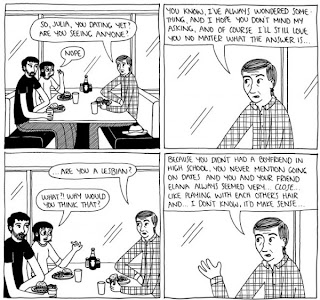
Wertz’s family is a constant in this book, and it’s obvious that they not only mean a lot to her, but that they contribute significantly to her daily happiness. Even her father, with whom Julia and her siblings have a somewhat tense relationship, is still portrayed as a kind of weird, lovable crank. While their points of view are wildly divergent in many ways, Wertz’s pride in her mother’s accomplishments is obvious. (It’s always funny when Wertz censors herself because “my ma is gonna read this!”) The sections of the book where a teenaged Wertz has to look after her toddler younger brother are some of my favorites in the book. For someone who has noted elsewhere that she has no desire to become a mother, Wertz is astonishingly good at depicting the behavior of children in a manner that is both affectionate and truthful. While the last thing a teen might want to do is look after their younger brother, there’s a remarkable presentness in how Wertz approaches him, knowing just how to interact with him.


The most important family member portrayed in this book is Julia’s older brother Josh. From the very beginning of the book, when young Josh and Julia are disappointed to be told they can’t marry, only to recoil in disgust when they’re told what marriage is all about (“Now I don’t ever want to be married!”), the duo are their own comedy team. The dialogue that Wertz depicts in this book between them is not only some of the funniest stuff in the book, it also points to their genuine sense of connection, Wertz’s dependence on him during a key period of her life, and an understanding of how to display affection despite their mutual discomfort with sharing and displaying emotions. Josh shows up as a partner-in-crime in a hilarious anecdote about a newspaper job where a lot of hijinks ensued, as a comfort to Wertz when she was seriously ill, and as someone who devoured books the same way she did. Wertz’s upbringing was obviously far from perfect, but despite a weird and turbulent childhood, the warmth with which Wertz discusses her family and how much their travails and successes affects her everyday life is obvious and unusual in most autobio comics. The fact that Josh reads Wertz’s first attempts at making comics and encourages her to do more is obviously something that spurred on her career.


Work and Purpose


“Industry” is clever because its episodic nature allows Wertz to linger on her childhood as much as she does her young adult years. Wertz’s line remains as crude as ever in terms of portraying caricatures of others (her drawings of faces are approximations at best), but she’s aces at depicting body language–especially when kids are involved. When young Julia is disappointed, Wertz loves drawing the stiff, arms-forward pose of righteous indignation– a pose she also draws for the adult version of her self-caricature. This is the section of the book that’s packed with the most gags, as the cynical and occasionally misanthropic Wertz manages to simultaneously piss people off as a waitress while revealing a tireless work ethic. Wertz shoots fish in a barrel with a bazooka with her hilarious accounts of customers obsessed with ranch dressing, the politics of upscale restaurants, sleazy pizza shop owners, etc. Her breathless account of the differences between baby sitting now and twenty years ago (focusing on how much stricter modern parents are now regarding food, TV, etc.) is the longest sustained laugh in the book.


Underlying all of the funny business is the first mention of her alcoholism and how it started to affect her life. In a very matter-of-fact fashion, she relates how it cost her a couple of her jobs. The realization that she had no one to blame but herself for being fired is a dark moment, one made darker when she essentially skates right past it on her way to other jobs. It’s also balanced by her discovery of comics and the realization that she finally found what she really wanted to do after a lifetime of drifting and finding that she was good at something that wasn’t especially meaningful (waiting tables). Even as her drinking problem got worse before it got better (and Wertz notes that this is an ongoing battle), the fact that she could make a living off of doing comics and even be tempted by optioning her life story to Hollywood was an astonishing positive, one made all the more meaningful when she more fully came to terms with her problems.


Relationships vs Solipsism


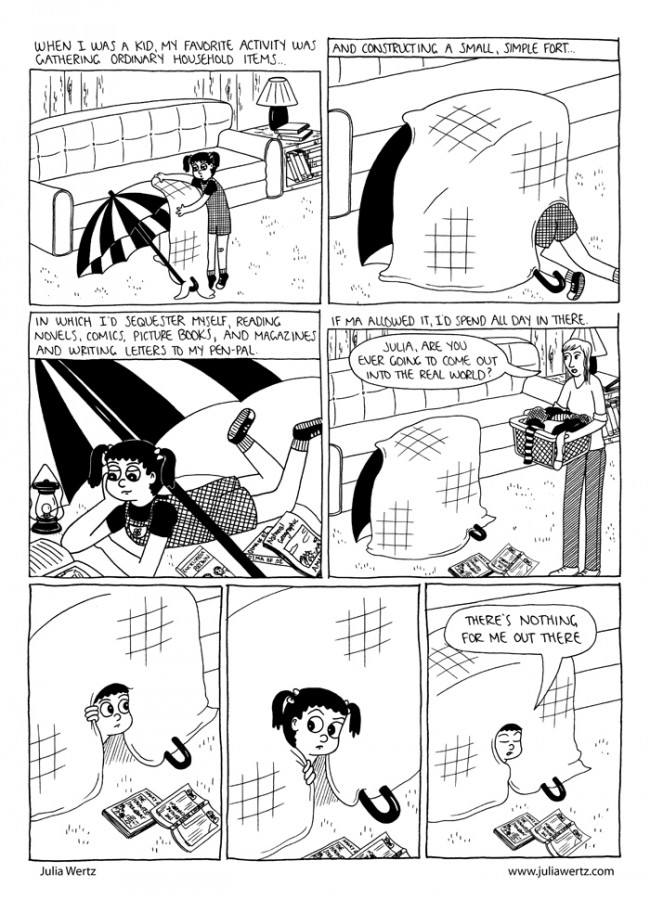
In “A Strange and Curious Place”, young Julia makes a fort in the living room and declares, upon poking her head out after her mother inquires after her, “There’s nothing for me out here.” She was happy to be in there with her books. Wertz goes into detail about an almost fetishistic love of books, down to the smell and feel of paper. Part of this is fueled by Wertz’s lifelong distaste for being a joiner; she wasn’t continually misanthropic, of course, but she never faked it to fill in. Once again, comics had a huge impact on her life, as she met dozens of cartoonists during a cross-country trip who wound up becoming life-long friends. In her comics, Wertz portrays the way she expresses her emotions as something mediated through various filters, like jokes with her brother. Comics became a filter with which she could develop close friendships built around a common passion, especially considering how bookish and introverted many cartoonists tend to be. Each of the three chapters ends with Wertz eventually expanding her range of relationships during different periods of her life, but there’s no question that she depicts herself as going from closed off to more open to opportunities in each story.


Alcoholism


Wertz notes in the book that she originally intended her follow-up to her book Drinking At The Movies to be about her experiences with alcoholism and rehab. Finding this to be a joyless, frustrating task, she almost lost her taste for creating art until her brother told her that doing a book about one’s own alcoholism in the middle of combating said problem seems counter-productive for both endeavors. The simple suggestion to do something else eventually helped spawn this book. That said, being an alcoholic pervades much of the book. Beyond getting her fired from a couple of jobs, it led her to go the solipsistic route of cutting off most contact because it helped enable her drinking. Simply by acknowledging this now and connecting this heretofore unexplored aspect of her life to other life events, she’s already laid the ground for future explorations of the issue–if she chooses to do so. All I know is that a Wertz-penned book about rehab, even if it has its harrowing moments, is as likely to be as hilarious as anything else she’s done.


Disease


Wertz is quick to note that as unpleasant as her experience with systemic lupus was over the many months it turned her into jelly, she realizes that she was never hospitalized and never faced the sort of struggle that a cancer patient might. That said, The Infinite Wait acts as a kind of antidote to the many Disease Comics that have been published in recent years. That’s especially true in the scenes Wertz depicts of being in a doctor’s office and taking in horrible information in a matter-of-fact fashion. It’s true that Wertz tends to react to extreme news in a nonchalant way as a means to delay or deflect feeling strong, negative emotions, but it’s also true that this is simply part of her personality. Wertz goes into a lot of detail about how her experience with the symptoms of lupus altered her life, stopping short of a PSA but not glossing over the experience either. The scenes with her brother act as a way of grounding her experiences, venting her fears while trading terse one-liners with her sibling. Once again, comics come into play as something she started reading on a whim when regular books tended to exhaust her in her weakened state. She thought comics would be something simple to read but found that her mind was blown by the sheer possibilities that comics had to offer–so much so, that she picked up a pen.


Aesthetic Joy


The Wertz character is a cranky, complaining sort, with the complaints being played mostly for laughs (both at her expense as well as others). The reality is that while a lot of things annoy Wertz, there are even more that delight her. That’s why “A Strange and Curious Place” is such a fun and even inspiring story. With a remarkable level of detail, she discusses not only the books that transformed her life but the building that housed them as one that had mysterious, “adult” properties. Wertz really knows how to get to the essence of places and people and talk in very specific terms about what makes them wonderful or terrible. She has the rare ability of being an astute observer with a sharp mind for constructing and relating vivid, funny anecdotes. Her voice as an author is so strong that these anecdotes, even when presented in a fairly straightforward, episodic manner, always feel organically constructed. Her art really shines when bringing to life an old, beloved street or the house she grew up in.


Her inability to draw convincing faces sometimes interferes with her narratives and is at odds with the way she’s able to simply but competently draw anything else. At the very least, she draws recognizable figures that are easy to track across the book. It’s just unfortunate that part of the punch of her work is muted in that regard. The other problem that Wertz has is a maddening propensity for typos and spelling errors. This book also had a duplicate page in addition to dropped letters, repeated words and other things that should have been picked up by a copy editor. It didn’t affect my enjoyment of the book, but I did find it distracting. Wertz has grown by leaps and bounds into one of comics’ best memoirists and funniest writers, and one gets the sense that the best is yet to come from her. The Infinite Wait feels like a book where the author is taking stock of her own career and starts to beat a new path for herself while shedding new light on old work. By going over old territory with new insights, Wertz not only makes those older books better in light of what is revealed here, she has also crafted a moving and funny new work that’s the best of her career to date.


Sunday, December 16, 2012

Christmas through the Decades: Star Spangled Comics #77, 1947

Christmas 1947… and in the pages of Star Spangled Comics #77 Robin the Boy Wonder was about to engage in “An Unusual Holiday Adventure” as he solved the case of “The Boy Who Wanted Robin for Christmas”.

Orphaned boy billionaire Bert Beem has all that money could buy so what do you get the kid who has everything for Christmas? Well, as Bert has been obsessing over his hero Robin (coincidentally also an orphan residing in the lap of luxury at Wayne Manor) – and letting his interest in the family business slide – how about setting up a fake case where Bert gets to test out his detective skills side by side with his favourite boy hero?

With Robin colluding with Bert’s guardian and his butler to stage a pretend robbery at the Beem Cliffside estate the stage is set for an encounter with a jolly gun-wielding Santa Claus burglar. What boy could ask for more at the season of goodwill? For some strange reason it should also be noted that Bert, a child, is home alone for the holidays so clearly, at this point, we can say his guardian is doing a rather sterling job of looking after his welfare.


Robin, rather than phoning social services to report Bert’s guardian for reckless child endangerment on a number of counts, goes along with this ruse. But everything goes pear-shaped when the “actors” hired to pull off the fake burglary turn out to be real criminals. After lots of festive frolics, including a sleigh ride to near doom on the estate grounds, the two chums finally unmask “Santa” who turns out to be the Beem family butler all along. And so, with the ghastly working class oik apprehended and thrown in the slammer, 1947 turns out to be a super Christmas for spoilt rich kids everywhere! Hurrah!

Of course Golden Age stories were never meant to be over-analysed, nor read by men of 40+ years of age either for that matter, so all gentle (and fondly meant) mockery is largely irrelevant. "The Boy Who Wanted Robin for Christmas" has its own naive Yuletide charm and is a welcome reminder of a more innocent era of DC history.

Friday, December 14, 2012

War Nurse: Alone

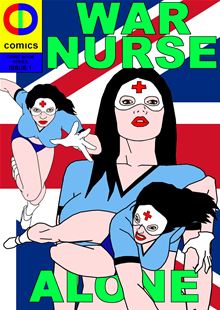
In 1938 Hitler unified Austria with Nazi Germany and on September 29th the Munich Agreement handed over the Czechoslovakia’s Sudetenland to the Nazis. Prime Minister Chamberlain said it gave us ‘peace for our time’ and Hitler was selected Time magazine's Man of the Year for 1938. Hitler’s forces invaded western Poland on September 1st 1939 and two days later Britain, France, Australia and New Zealand honoured their pact with the Polish and declared war on Germany. In 1940 Hitler proclaimed the birth of the ‘Greater Germanic Reich’ and Mussolini’s Italy joined the Axis forces before France surrendered on June 22nd, Leaving Britan alone in Europe. The Blitz on London started on September 7th 1940 and on the second night St Thomas Hospital where Nurse Patricia Parker was working was bombed. Four days later she becomes War Nurse when faced with a U-Boat full of Nazis just off the south coast, who were planning to kill the new Prime Minister, Winston Churchill. The occult and 5th Columnist subplots with this comic set the scene for feature issues and introduce several supporting characters. War Nurse is a Domain Free character and other Golden Age Domain free characters will also make appearances in later issues, including the Black Cat and Kitten, Octobriana and many more. For more information and images visit www.cdgraphicnovels.blogspot.com

Before Watchmen: Dr. Manhattan #3

Fans of the character get more insight into the world's most powerful and complicated man.

The Good

A lot of the concepts and themes that were present on the surface of this series in previous issues are explored in greater length here. The extent of Dr. Manhattan's powers, for example, is one of those issues. What can he do, exactly? When he changes the outcome of an event, does that mean that he simply changed the future, or did he unintentionally create a new timeline where a new possibility exists? Meanwhile the old possibility still exists, as well? One thing is for sure, if anyone can write existentialism and integrate head-scratching concepts like whether or not time is relative to life/a story; it's J. Michael Straczynski. If you aren't used to reading stories that deal with past present and future, and that define time and space, Straczynski provides a story that touches on those concepts and explains them in a simplified way. That's certainly one of the things I enjoyed about this issue.


However it isn't the story that is guaranteed to blow you away so much as the art. The art in this comic is absolutely jaw-dropping. Reading this issue is a process. Each page of this comic is more detailed than last, and helps to tell the story in an incredible way. Hughes' work is so abstract and different; the way he illustrates each panel is so brilliant that you will be drawn into this gorgeous comic for his skill alone. It's like seeing a Norman Rockwell painting come to life, that's how beautiful it is.
The Bad

I think the purpose of these BEFORE WATCHMEN titles is to add some depth or dimension to characters that we met in Moore's WATCHMEN title. I would think the purpose is to find how these characters are grounded and what drives them. Although we have one issue left to go, it doesn't really feel like Straczynski humanizes Dr. Manhattan in his series, which is something I had expected him to do. Unlike other heroes in WATCHMEN, Manhattan undergoes a change that takes him from being a human male with an ordinary life, to a super-powered being who is completely detached from society.
The Verdict

This issue features a lot of flashbacks that gives readers a closer look at Dr. Manhattan's life before he became Dr. Manhattan. We see him as a child and become acquainted with his father. Straczynski also goes on to explore that particular relationship. I think the only problem with this is the fact that it doesn't quite tell us who the character is. What was his personality like? Was he a moral person? How did he meet his first wife? There's just a ton that we don't know about Dr. Manhattan even after having read the three issues of his BEFORE WATCHMEN mini-series. So, at the end of the day, who is he exactly? What was the purpose of this series? Still, beyond all that, the issue itself is very well written, well organized and Straczynski certainly plays to Hughes' strengths. Hughes knocks the art in this issue out of the park completely, delivering a just absolutely stunning piece of work

Tuesday, December 11, 2012

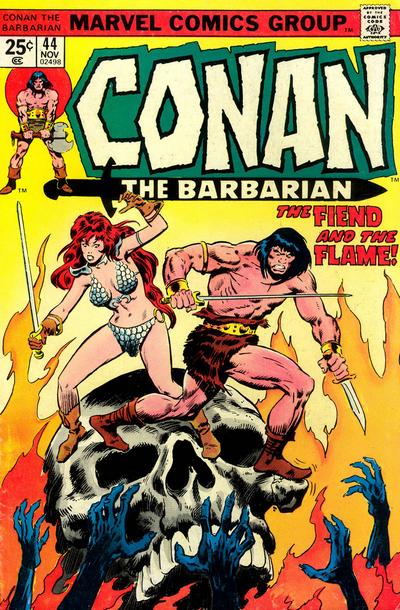
Conan the Barbarian Vol.1 #44

Sonja and Conan plot their escape from the vampiric siblings Uathacht and Morophia, but Morophia intervenes and takes Conan to the breeding pits, where he is forced to mate with the generations-inbred, pitiful, deformed females who provide sustenance for the vampires. Uathacht, fearing that too much of such things would break Conan's mind, and wanting the barbarian for herself, appears to Conan and Sonja and agrees to cast a spell to weaken her brother in order to free Conan, so he may willingly fulfill her hedonistic fantasies. Conan agrees, but only if Sonja is set free as well, and while at first Uathacht agrees, she reneges and Sonja is forced to kill her. Conan and Sonja attempt to flee the Tower of Blood, but first encounter a group of the bat-like Afterlings, who reveal that in Morophia's weakened state, they are free of his control and they show the two humans the way out. They intend to burn the tower down, but soon, they encounter the vampire himself, who transforms into the form of several of Conan's past enemies, but Conan and Sonja manage to start a fire to burn the vampire to a final death. Unfortunately, they are trapped in flames at the top of the tower, and as they make their way down the walls, they slip and fall, only to be rescued by the Afterlings, who carry them to the cavern floor. Sonja, believing she is acting in Conan's best interest and wanting to spare him from the bounty hunters who are chasing her, knocks him cold with a rock and rides away.

Sunday, December 9, 2012

100 Bullets Book 1

In the opening chapters, Dizzy Cordova, a Latina gangbanger who has just finished a prison sentence, is given the chance to avenge her family's murders, and a downtrodden bartender receives the opportunity to exact revenge against the woman who ruined his life.

Then, as Agent Graves continues to approach and manipulate his "clients," questions about the ghoulish agent start to arise as people from his past begin to appear, revealing interesting information about their former acquaintance.

And in this volume's third arc, Graves pulls a young man by the name of Loop Hughes into his web of intrigue and deception. Armed with one of Graves's briefcases, Loop tracks down his long-lost father and is soon drawn into the world of mob enforcement.

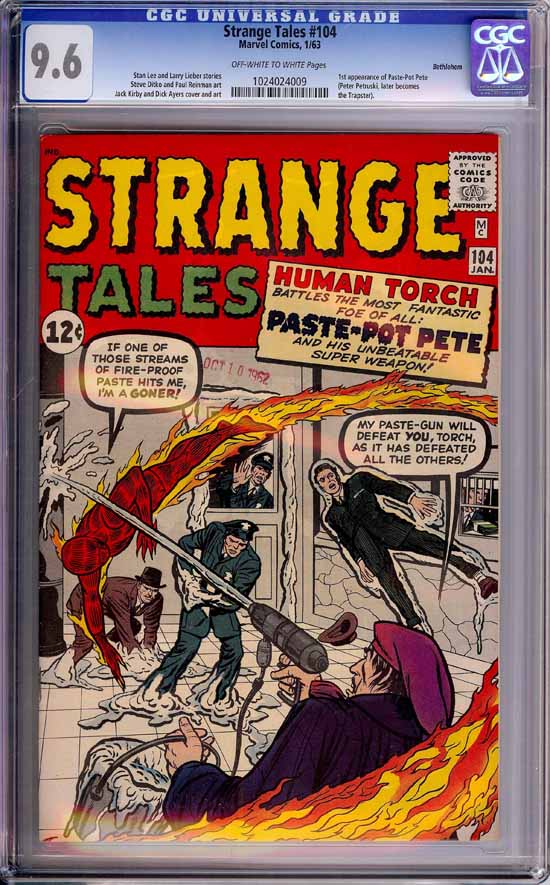
Strange Tales #104

The best existing copy!!! It was the first 9.6 certified until 3 other graded 9.6's decided to join in on all the fun. From the incredible Bethlehem Collection, this copy is pure eye candy. The pages are an outstanding off-white to white, the centering is PERFECT, the edges and corners are razor sharp and the spine is legitimately immaculate. Plus, it is crazy glossy and the background reds will blow you away. Features the introduction of Paste-Pot Pete with a cool Jack Kirby/Dick Ayers cover. Contains the tell-tale date stamp on the front cover ("OCT 10 1962") that identifies this comic as being from the Bethlehem Collection.

Uncanny X-Men #538

We know Uncanny X-Men is coming to an end but this conclusion to Breaking Point makes it feel like this was the end.

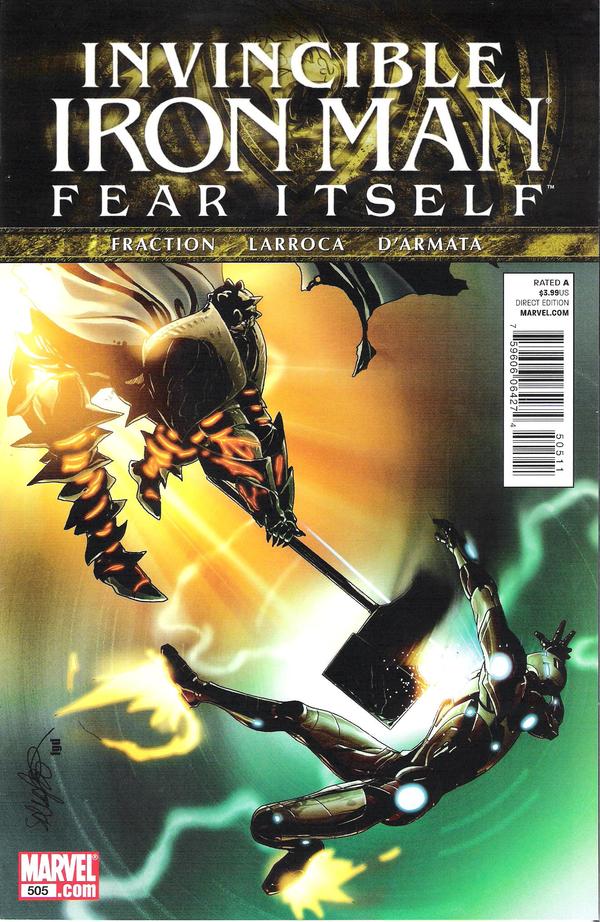
Invincible Iron Man #505

Last month I referred to Invincible Iron Man 504 as the best Fear Itself tie-in that's come out so far. The storyline continues this month with some baffling choices and some darkness looming on the horizon.

i Love Trouble

What better time to discover a special talent when you find yourself about to die? Get ready for a comic that isn't full of the usual familiar type of characters.

Sunday, October 28, 2012

Daytripper

The creators of Daytripper want nothing less than to convince you that the world is a wonderful place. Its themes are grand, ambitious, and writ in big, bold letters: Life is full of beauty, mystery, and magic; minor miracles occur every day; the tenuousness of it all—that a seemingly random event could snuff out our life—is what makes existence so precious; and despite whatever pain and sorrow we experience, it’s all worthwhile.

To which I want to add, “Yes, but only sometimes.” Life can be inexpressibly rewarding and beautiful, but it can also be savage and unrelentingly brutal, and to focus on the sunny side of the road while forsaking the other is to give in to a lop-sided sentimentalism. I’m not sure that many of those who are living in the worst sort of poverty, under oppressive regimes, or suffering from severe illness would appreciate creators Fábio Moon and Gabriel Bá’s central thesis. It’s not impossible to feel the sort of appreciation that the cartoonists seek to cultivate, but certainly it helps if you’re not worrying about where your next meal is coming from or if you will be tossed in prison because you forgot to wear the proper pin. I’m always wary of throwing out Marxist terms, but Daytripper strikes me as a very naïve, and very bourgeois, book.

The comic follows the life—or lives as the case may be—of Bras de Oliva Domingo, the son of a famous Brazilian novelist who struggles as an obituary reporter before finding his voice, becoming a respected writer in his own right, and finding not only success, but also true love and a dutiful son.

The catch is that a) Bras’ life story is told out of order; and b) he dies at the end of every chapter. Yes, the final page of each chapter, which to some degree relates a pivotal or at least memorable moment in Bras’ life, ends with him dying, violently or otherwise, only to have him reappear one page later, seemingly none the worse for wear. (This effect can at times be frustrating when a particularly intriguing cliffhanger is arranged only to be quickly forgotten so Bras can tackle another of life’s rich moments.) Whether these deaths actually occur, whether we’re seeing Bras from parallel universes, or whether he’s simply imagining the whole thing is hinted at but never fully explained.

No doubt the central idea behind the constant, seemingly random deaths is to underscore the aforementioned tenuousness of life, how things can be seemingly thrown into chaos at the most random times, and how such a realization should force us to better appreciate the moments we are allowed to live and experience. By about halfway through the book, however, it starts to feel like little more than a plot gimmick, with the reader no longer thinking such thoughts as, “Oh, how tragic,” or, “This sad ending reminds me I must reassess my own priorities and values,” but instead: “Gee, I wonder how he’s going to kick the bucket this time?”

The central problem with Daytripper, though, lies with the character of Bras himself, who lives one of the most charmed lives ever depicted in comics (which is saying something). Yes, life surely is a magical fairy tale of wonder and happiness: if you happen to be the son of a famous novelist, get to become a famous novelist yourself, find true love, have a wonderful marriage, raise a great son, and live your old age out on a beach where goldfish kites continually sway in the breeze. Despite his repeated deaths, Bras never really suffers; not in any way that seems unjust or tragic, as happens to the rest of us sooner or later (even his father’s death has a poetic resonance, as it just happens to occur the same day his son is born). Bras’s sweet life is a gift; it’s never earned and never questioned.

As a result, Bras becomes a bit insufferable. He seems to suffer from a bit of narcissism. His wife and son seem less like characters than extensions of himself, ways to help him appreciate the beauty of it all. The few times that the book starts to take an interesting turn is when other characters—a rarely mentioned illegitimate half-sister, a friend who for inexplicable reasons goes off the deep end—force their way into the narrative. But their perils are quickly abandoned and forgotten, perhaps because examining their plights might force the authors to reassess the book’s values.

Moon and Bá are considerable talents, as Casanova, Umbrella Academy, and other works have proven. They remain astoundingly good craftsmen here as well—the book moves swiftly and concisely, and is filled with lovely vistas and some wonderful character types and expressions, all nobly abetted by Dave Stewart’s lush colors. The dialogue never feels forced or awkward, even in its more high-handed moments. It’s a well-made comic. But the ultimate question is not whether Daytripper is well done, but whether it is saying anything worthwhile. Not for me it isn’t.