In a sense, the heart of each of the three short stories in Julia Wertz’s memoir The Infinite Wait is the impact that discovering comics has had on her life. Ostensibly, the book is broken up into “Industry”, a chronological account of her life as seen through her job history; “The Infinite Wait”, her account of learning that she suffered from chronic systemic lupus; and “A Strange and Curious Place”, a love letter to the first public library she haunted as a child. While each story can be read as discrete narratives, the truth is that this book is a sort of recapitulation and revisitation of the themes and events she explored in her first three books (The Fart Party Volumes 1 & 2; Drinking At The Movies). There’s a deeper level of narrative, thematic and emotional complexity that becomes more apparent as one reads the book for a second time. Wertz doesn’t exactly disown her earlier works in this book, but she goes into detail as to why each of them make her uncomfortable from her current perspective.
In the interest of full disclosure, I blurbed the book. I wrote, “Julia Wertz has become one of the most bracingly raw and honest autobiographical cartoonists without losing an ounce of her irreverent, silly, profane and scathing sense of humor.” That latter point must be emphasized: though Wertz takes on some serious topics and reveals some harsh truths about herself in the course of the book, her sense of comic timing has never been better. While each story does have a roughly chronological narrative structure, Wertz rambles, goes on tangents, and diverges into events and themes that aren’t directly related to the ostensible subject of each chapter. The result is a book that’s all over the place in the best possible sense, as her divergences and references to past books and past events, as well as the way she retells certain events from a different point of view, speak to the complicated, messy way life is lived and experienced.
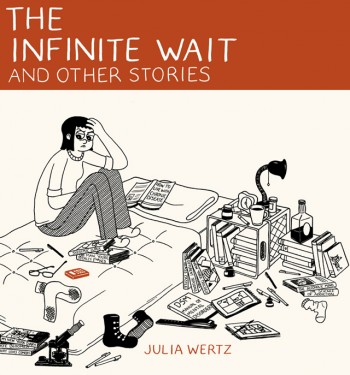
The cover of the book offers a number of clues to the reader as to what should be expected. A scowling Wertz is sitting on her bed but is nonetheless surrounded by things that are important to her: pens, ink, paper, comics (including the three that were name-checked as big early influences: Julie Doucet’s My New York Diary, Ivan Brunetti’s Misery Loves Comedy, and Carol Tyler’s Late Bloomer), a bottle of whiskey, books about alcoholism and addiction, books about mental illness, books about lupus (including one “titled” Oh Man You’re Totally Fucked) and several other books that have meaning for her. Those comics choices are especially interesting, because I can see elements of the three seemingly disparate cartoonists in her work. She clearly embraced the ramshackle, warts-and-all quality of Doucet’s autobio, the take-no-prisoners humor of Brunetti, and the genuine warmth and emphasis on family present in Tyler’s work. In thinking about Wertz’s book, I think it’s best addressed going theme by theme rather than examining individual stories. From examining the parts, an interesting picture emerges.
Family
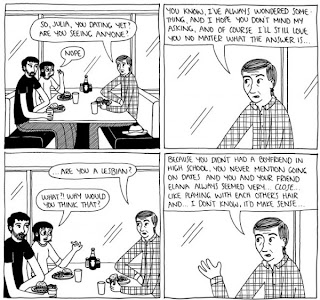
Wertz’s family is a constant in this book, and it’s obvious that they not only mean a lot to her, but that they contribute significantly to her daily happiness. Even her father, with whom Julia and her siblings have a somewhat tense relationship, is still portrayed as a kind of weird, lovable crank. While their points of view are wildly divergent in many ways, Wertz’s pride in her mother’s accomplishments is obvious. (It’s always funny when Wertz censors herself because “my ma is gonna read this!”) The sections of the book where a teenaged Wertz has to look after her toddler younger brother are some of my favorites in the book. For someone who has noted elsewhere that she has no desire to become a mother, Wertz is astonishingly good at depicting the behavior of children in a manner that is both affectionate and truthful. While the last thing a teen might want to do is look after their younger brother, there’s a remarkable presentness in how Wertz approaches him, knowing just how to interact with him.
The most important family member portrayed in this book is Julia’s older brother Josh. From the very beginning of the book, when young Josh and Julia are disappointed to be told they can’t marry, only to recoil in disgust when they’re told what marriage is all about (“Now I don’t ever want to be married!”), the duo are their own comedy team. The dialogue that Wertz depicts in this book between them is not only some of the funniest stuff in the book, it also points to their genuine sense of connection, Wertz’s dependence on him during a key period of her life, and an understanding of how to display affection despite their mutual discomfort with sharing and displaying emotions. Josh shows up as a partner-in-crime in a hilarious anecdote about a newspaper job where a lot of hijinks ensued, as a comfort to Wertz when she was seriously ill, and as someone who devoured books the same way she did. Wertz’s upbringing was obviously far from perfect, but despite a weird and turbulent childhood, the warmth with which Wertz discusses her family and how much their travails and successes affects her everyday life is obvious and unusual in most autobio comics. The fact that Josh reads Wertz’s first attempts at making comics and encourages her to do more is obviously something that spurred on her career.

Work and Purpose
“Industry” is clever because its episodic nature allows Wertz to linger on her childhood as much as she does her young adult years. Wertz’s line remains as crude as ever in terms of portraying caricatures of others (her drawings of faces are approximations at best), but she’s aces at depicting body language–especially when kids are involved. When young Julia is disappointed, Wertz loves drawing the stiff, arms-forward pose of righteous indignation– a pose she also draws for the adult version of her self-caricature. This is the section of the book that’s packed with the most gags, as the cynical and occasionally misanthropic Wertz manages to simultaneously piss people off as a waitress while revealing a tireless work ethic. Wertz shoots fish in a barrel with a bazooka with her hilarious accounts of customers obsessed with ranch dressing, the politics of upscale restaurants, sleazy pizza shop owners, etc. Her breathless account of the differences between baby sitting now and twenty years ago (focusing on how much stricter modern parents are now regarding food, TV, etc.) is the longest sustained laugh in the book.
Underlying all of the funny business is the first mention of her alcoholism and how it started to affect her life. In a very matter-of-fact fashion, she relates how it cost her a couple of her jobs. The realization that she had no one to blame but herself for being fired is a dark moment, one made darker when she essentially skates right past it on her way to other jobs. It’s also balanced by her discovery of comics and the realization that she finally found what she really wanted to do after a lifetime of drifting and finding that she was good at something that wasn’t especially meaningful (waiting tables). Even as her drinking problem got worse before it got better (and Wertz notes that this is an ongoing battle), the fact that she could make a living off of doing comics and even be tempted by optioning her life story to Hollywood was an astonishing positive, one made all the more meaningful when she more fully came to terms with her problems.

Relationships vs Solipsism
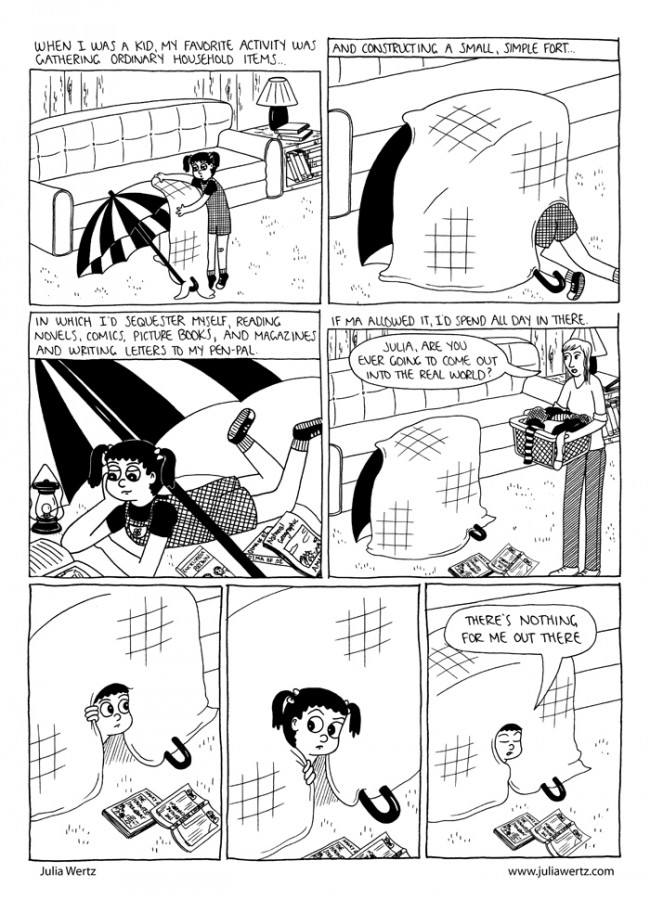
In “A Strange and Curious Place”, young Julia makes a fort in the living room and declares, upon poking her head out after her mother inquires after her, “There’s nothing for me out here.” She was happy to be in there with her books. Wertz goes into detail about an almost fetishistic love of books, down to the smell and feel of paper. Part of this is fueled by Wertz’s lifelong distaste for being a joiner; she wasn’t continually misanthropic, of course, but she never faked it to fill in. Once again, comics had a huge impact on her life, as she met dozens of cartoonists during a cross-country trip who wound up becoming life-long friends. In her comics, Wertz portrays the way she expresses her emotions as something mediated through various filters, like jokes with her brother. Comics became a filter with which she could develop close friendships built around a common passion, especially considering how bookish and introverted many cartoonists tend to be. Each of the three chapters ends with Wertz eventually expanding her range of relationships during different periods of her life, but there’s no question that she depicts herself as going from closed off to more open to opportunities in each story.
Alcoholism
Wertz notes in the book that she originally intended her follow-up to her book Drinking At The Movies to be about her experiences with alcoholism and rehab. Finding this to be a joyless, frustrating task, she almost lost her taste for creating art until her brother told her that doing a book about one’s own alcoholism in the middle of combating said problem seems counter-productive for both endeavors. The simple suggestion to do something else eventually helped spawn this book. That said, being an alcoholic pervades much of the book. Beyond getting her fired from a couple of jobs, it led her to go the solipsistic route of cutting off most contact because it helped enable her drinking. Simply by acknowledging this now and connecting this heretofore unexplored aspect of her life to other life events, she’s already laid the ground for future explorations of the issue–if she chooses to do so. All I know is that a Wertz-penned book about rehab, even if it has its harrowing moments, is as likely to be as hilarious as anything else she’s done.
Disease
Wertz is quick to note that as unpleasant as her experience with systemic lupus was over the many months it turned her into jelly, she realizes that she was never hospitalized and never faced the sort of struggle that a cancer patient might. That said, The Infinite Wait acts as a kind of antidote to the many Disease Comics that have been published in recent years. That’s especially true in the scenes Wertz depicts of being in a doctor’s office and taking in horrible information in a matter-of-fact fashion. It’s true that Wertz tends to react to extreme news in a nonchalant way as a means to delay or deflect feeling strong, negative emotions, but it’s also true that this is simply part of her personality. Wertz goes into a lot of detail about how her experience with the symptoms of lupus altered her life, stopping short of a PSA but not glossing over the experience either. The scenes with her brother act as a way of grounding her experiences, venting her fears while trading terse one-liners with her sibling. Once again, comics come into play as something she started reading on a whim when regular books tended to exhaust her in her weakened state. She thought comics would be something simple to read but found that her mind was blown by the sheer possibilities that comics had to offer–so much so, that she picked up a pen.

Aesthetic Joy
The Wertz character is a cranky, complaining sort, with the complaints being played mostly for laughs (both at her expense as well as others). The reality is that while a lot of things annoy Wertz, there are even more that delight her. That’s why “A Strange and Curious Place” is such a fun and even inspiring story. With a remarkable level of detail, she discusses not only the books that transformed her life but the building that housed them as one that had mysterious, “adult” properties. Wertz really knows how to get to the essence of places and people and talk in very specific terms about what makes them wonderful or terrible. She has the rare ability of being an astute observer with a sharp mind for constructing and relating vivid, funny anecdotes. Her voice as an author is so strong that these anecdotes, even when presented in a fairly straightforward, episodic manner, always feel organically constructed. Her art really shines when bringing to life an old, beloved street or the house she grew up in.
Her inability to draw convincing faces sometimes interferes with her narratives and is at odds with the way she’s able to simply but competently draw anything else. At the very least, she draws recognizable figures that are easy to track across the book. It’s just unfortunate that part of the punch of her work is muted in that regard. The other problem that Wertz has is a maddening propensity for typos and spelling errors. This book also had a duplicate page in addition to dropped letters, repeated words and other things that should have been picked up by a copy editor. It didn’t affect my enjoyment of the book, but I did find it distracting. Wertz has grown by leaps and bounds into one of comics’ best memoirists and funniest writers, and one gets the sense that the best is yet to come from her. The Infinite Wait feels like a book where the author is taking stock of her own career and starts to beat a new path for herself while shedding new light on old work. By going over old territory with new insights, Wertz not only makes those older books better in light of what is revealed here, she has also crafted a moving and funny new work that’s the best of her career to date.

.jpg)