Showing posts with label Articles. Show all posts

Saturday, December 29, 2012

Comics: Legion of Super-Heroes – Hostile World

Legion of Super-Heroes: Hostile World

Paul Levitz (script)

Francis Portela (art)

DC Comics, 2012

The company-wide “New 52″ reboot that DC Comics has used to re-envision (and, they hope, revitalize) their comic book line is nearly a year old. The graphic novel collections of its first story-arcs are starting to appear, offering die-hard and fair-weather fans alike an opportunity to take stock. The “New 52″ restart worked well financially for DC – it imparted a jolt of enthusiasm to their line, increased sales dramatically, and may have netted them some new readers (in a sure sign that money talks, DC’s rival in the super-hero game, Marvel Comics, will be trying something vaguely similar this fall). But was it a success from a purely comics point of view?


The answer (despite some notable exceptions) is clearly ‘no.’ Fringe characters like Animal Man or Swamp Thing might be temporarily benefiting from the attention of some top-notch writers and artists, but in the main crowd of DC’s marquee-name super-characters, it’s telling to realize that virtually all the successes are titles where the least changes were made. In the “Superman” titles, the incredibly rich history built up since John Byrne was allowed to go berserk on the character back in the 1980s was wiped out at a stroke, and in its place, we have an aloof and clueless super-being from another world, a character inconceivable to picture as a hero to anybody except a nerdy comic book fan. And this is gentle compared to the desecration wrought on one of the company’s other well-known properties: Wonder Woman has gone from a principled and extremely powerful Amazon ambassador (forged in clay by her mother and endowed with the powers of the gods) – a character who in recent years was finally being done right after decades of being done wrong – to a sword-wielding dime-a-dozen demi-god by-blow of an Olympian god, a derivative and forgettable generic warrior-woman.

Likewise Green Arrow (the utterly delightful recent depiction of the character as a slightly older and highly imperfect hero, lover, and father – wiped away), the venerable Justice Society (the highly respected multi-generational super-team that featured some of DC’s very first heroes – wiped away), and worst of all Batgirl (for years, the identity retired by a crippled Barbara Gordon, who learned instead to make a new life for herself in a wheelchair that didn’t in any way limit her potential and thus made her an inspiration to crippled young readers all over the world – now miraculously given back the use of her legs so she can leap around roof-tops at night) … all revamped into thinner, more brittle, entirely less imaginative versions of their earlier incarnations.

One of the few positive side-effects of the “New 52,” however, is that it managed to un-do some of the last lingering pre-reboot nonsense-changes made to another long-standing DC property, The Legion of Super-Heroes. For the last twenty years, roughly a dozen creators have done smaller but equally inane drive-by mini-overhauls of this title, which features the 31st Century adventures of the enormous titular team of super-powered teens from many different worlds, banded together to serve and protect the United Planets. DC gave each of those dozen or so creators license to warp and twist the Legion to suit their fancies, and the results were seldom good. One of the last such twistings was one of the biggest: to move the entire time-frame of the Legion stories forward a bit, so we were no longer talking about a team of teenagers. Instead, in several recent Legion story-lines, we’ve been presented with our familiar characters as bitter and grizzled adults. As odd as it must sound to the uninitiated, this last change felt particularly defeating – like a second end to childhood.

But one of the corporate mandates for the “New 52″ is that all the heroes be just a bit younger, and this has worked in the Legion’s favor: by some unintended miracle of uncoordinated hedge-clipping, the team has been brought squarely back to the conceptual ingredients of its greatest days: a sprawling, stalwart band of heroic young people banding together, squabbling amongst themselves, and fighting the good fight against both over-nice intergalactic diplomacy and overwhelming intergalactic super-threats.

A big part of what makes this new-old formula work is that it employs a writer who was actually responsible for many of those greatest days: veteran Legion-scripter Paul Levitz writes the seven issues now collected inLegion of Super-Heroes: Hostile World, and virtually every page shows his easy mastery of these characters and their complex sci-fi setting. His signature – multiple story-lines unfolding mostly parallel (one of the only effective ways to handle a team this big) and then converging to periodic little semi-conclusions – still works perfectly with this concept, and his characterizations of all the various team-members is pitch-perfect, as it’s been for a quarter of a century.

The main story-line inHostile World involves a renegade inhabitant of the quarantined planet Daxam, whose inhabitants are prevented from leaving their world by a crippling species vulnerability to heavy metals like lead (a vulnerability which causes some relief to the rest of the United Planets, since when Daxamites leave their homeworld, they gain all the unbeatable super-powers of Superman himself, Daxam and Krypton being similar kinds of places, you see). The renegade – a big jar-headed bruiser – has been supplied with a dangerously unstable antidote by long-term Legion enemies the Dominators, and the team eventually dispatches its own (heroic) Daxamite, Mon-el, to deal with the renegade (and the Dominator fleet that shows up to support him). The Legion’s resident super-genius, Brainiac 5, long ago developed a serum to cure Mon-el, although he’s unable to mass-produce it – so the action of that plot-line centers on the uber-geeky question of just how many Legion-members are capable of defeating a Daxamite one-on-one, or even holding their own. It’s good fun stuff, with hardly a stupid “New 52″ revamp in sight.

Levitz is aided in this fun by his regular artist Francis Portela, whose crisp work has an odd, off-kilter charm to it (and who rather unabashedly portrays all these adult Legion people as rather gorgeously statuesque at all times). And one of the issues reprinted here is drawn by industry legend Walt Simonson, an added bonus.

Which is good, since the graphic novel has virtually noother added bonuses. A few pages of rough-sketches are included at the back, but what readers really need – a simple one-page introductory summary of the last few big stories (the ones with direct effects on the events of this issue) – isn’t here, nor is it sufficiently alluded to in the body of the issues themselves. This cover of this volume runs a rather tepid blurb from IGN: “Most approachable jumping-on point for the Legion of Super-Heroes that you’ll get” – but that’s only true by default. It could have been a lot more approachable. That was supposed to be the whole point of the “New 52,” after all.

Nevertheless, this is sleekly done, wonderfully energetic treatment of the Legion of Super-Heroes. Considering how much worse things could have gone this year for this title, long-time fans should rejoice

By Steve Donoghue

Sunday, December 16, 2012

Christmas through the Decades: Star Spangled Comics #77, 1947

Christmas 1947… and in the pages of Star Spangled Comics #77 Robin the Boy Wonder was about to engage in “An Unusual Holiday Adventure” as he solved the case of “The Boy Who Wanted Robin for Christmas”.

Orphaned boy billionaire Bert Beem has all that money could buy so what do you get the kid who has everything for Christmas? Well, as Bert has been obsessing over his hero Robin (coincidentally also an orphan residing in the lap of luxury at Wayne Manor) – and letting his interest in the family business slide – how about setting up a fake case where Bert gets to test out his detective skills side by side with his favourite boy hero?

With Robin colluding with Bert’s guardian and his butler to stage a pretend robbery at the Beem Cliffside estate the stage is set for an encounter with a jolly gun-wielding Santa Claus burglar. What boy could ask for more at the season of goodwill? For some strange reason it should also be noted that Bert, a child, is home alone for the holidays so clearly, at this point, we can say his guardian is doing a rather sterling job of looking after his welfare.


Robin, rather than phoning social services to report Bert’s guardian for reckless child endangerment on a number of counts, goes along with this ruse. But everything goes pear-shaped when the “actors” hired to pull off the fake burglary turn out to be real criminals. After lots of festive frolics, including a sleigh ride to near doom on the estate grounds, the two chums finally unmask “Santa” who turns out to be the Beem family butler all along. And so, with the ghastly working class oik apprehended and thrown in the slammer, 1947 turns out to be a super Christmas for spoilt rich kids everywhere! Hurrah!

Of course Golden Age stories were never meant to be over-analysed, nor read by men of 40+ years of age either for that matter, so all gentle (and fondly meant) mockery is largely irrelevant. "The Boy Who Wanted Robin for Christmas" has its own naive Yuletide charm and is a welcome reminder of a more innocent era of DC history.

Saturday, December 15, 2012

Comics Versus Art

Its tempting to split up a review of Beaty’s book, Comics Versus Art, into a series of examinations of its individual chapters. Many of Beaty’s arguments are so relevant to the discussion of comics and wider culture that they deserve their own posts. More devilishly, its equally seductive to make a laundry list of his most controversial claims, just to see if they could nudge the Lichtenstein conversation out of its current emotional stalemate.

Either approach would be easier to write than an evaluation of the whole: Comics Versus Art is an ambitious but uneven chronicling of the diverse historical frictions between the two fields, including but not limited to pop-art appropriation, comic’s belittlement as nostalgic/primitive ephemera, and cartoonists’ ready cooperation with ‘art world’ prejudices. Beaty is a firebrand and much-needed documentarian, and his book is an invaluable contribution to this discussion. Through an interweaving of many rewarding tangents, he often succeeds at elucidating, even correcting, accounts of art-comics friction through a fair examination of each case’s larger context, even if some of his dramatic conclusions are shakily reached or unearned. Comics Versus Art is far from a manifesto of why comics should or should not be art. Without being vehement or trite, the book is quite damning in its examination of the petty status games that occur at the border between these worlds.

Comics Versus Art is comprised of nine different “case-studies.” The first chapter is especially worth summarizing, as it examines several different definitions of comics, and how these definitions, particularly Scott McCloud’s, have exempted comics from art history. While most definitions of comics have been essentialist, (focusing on recurring characters, thought balloons, or moral narrativising as central components, depending on the theory,) McCloud’s formalist definition is open enough to abduct and rename other phenomenon as “comics,” while it rejects several examples widely accepted as comics, (Dennis the Menace, for example.) While McCloud’s proponents are happy to re-envision Trajan’s Column as a comic, (and couldn’t care less about Dennis the Menace, perhaps,) the rest of the art world remains indifferent; as a freak, isolated case of comics, the column’s new branding doesn’t have nearly the historical interest as it’s status as imperial propaganda. More importantly, ‘comics,’ ‘children’s books,’ and ‘artists’ books’ are only distinguished by their audiences. At this point, Beaty introduces an institutional definition of comics, borrowed from Arthur C. Danto, George Dickie and Howard Becker’s theories of an “artworld.” Loosely, comics are whatever the human members of the comics world (including but not limited to producers, critics and consumers,) deem to be called comics. This theory fails even more spectacularly in establishing borders with children’s and artist’s books, but that’s somewhat the point, and at least it’s honest about it: Becker writes that “‘art worlds typically have intimate and extensive relations with the worlds from which they try to distinguish themselves.’” Problematically, this theory has no way of pinpointing why or what about comics makes them a social nexus, (perhaps, by the centrality of recurring characters in comics, people really do gather around commercial franchises rather than their formal attributes.) Beaty does good work here in positing a parallel comicsworld, but the definition is tautological and directionless, and doesn’t quite address where this would overlap with an artworld anyhow. Moreover, Beaty doesn’t develop the comicsworld theory beyond this point, and only occasionally reintroduces it in further chapters. He also doesn’t cover any of the historical evolutions in the definition of ‘art,’ contextualize how Danto and co.’s definition interact with these, or how it can be expanded past a truism. This unbalance plagues most of the book, where Beaty uses a limited range of analytical approaches to draw his conclusions, and doesn’t apply these tools strictly enough to spawn ideas past his original biases.

Beaty misses the opportunity to develop the institutional theory with the next chapter, which details the gendered power dynamic underlying the Lichtenstein appropriation debate. This study could have benefited from a closer look at the sub-worlds at play: much of the art-world initially rejected pop-art for its association with low-brow cultural forms, and only gradually began to recognize Lichtenstein’s work as worthwhile. This in turn would have clarified Chapter 6, where Beaty erroneously concludes that Gary Panter’s featuring in Blab! and Juxtapoz magazines, and creation of a vinyl art toy, signals his acceptance by the art world at large. Panter’s luke-warm reviews by Artforum, one of which is included in the book, are slightly better than the New York Time’s treatment of another comics luminary decades earlier, Bernard Krigstein, who is instead framed by the book as an artworld failure.

Despite this, Beaty’s arguments have an commonsensical ring of truth, which he occasionally goes out of his way to justify. On Lichtenstein, Beaty frames the case study with discussion of Nietzschean ressentiment, defined as “a tendency to attribute one’s personal failures to external forces.” This is a little overkill, where simply using the word ‘resentment’ could have done the trick, as Nietzche’s philosophies are not mentioned elsewhere in the book. However, Beaty is on the right track:


When, for example, Clive Phillpot offhandedly dismisses the possibility that works of comics might be classified as artist’s books, the division between forms is presented as a self-evident commonplace barely requiring elaboration or argumentation. By contrast, the pent-up aggressive feelings towards the world of fine arts that characterizes many cartoonist’s ressentiment can become an all-consuming passion that threatens to poison their work with an easily diagnosed bitterness.

It is a breath of fresh air to have the emotional dynamic of the Lichtenstein debate not only included in its context, but considered the heart of the conflict itself. In this case, he also studies how, evidenced by critics of the time, comics and kitsch were increasingly cast as feminine, while pop-art’s appropriations ‘masculinized’ camp that had been enjoyed in earnest. “Pop art, therefore, was a threat because it absconded with the one element that comic book fans assumed would never be in question: the red-blooded American masculinity that informed war and romance comics alike with their rigid adherence to patriarchal gender norms.” It is gender critique, not institutional theory, that becomes the lifeblood of Comics Versus Art, and provides a continuing thread through the other case studies, something that will fly in the face of readers not prepared to understand how certain behaviors and attitudes are routinely cast as ‘masculine’ and ‘feminine’ throughout history. Beaty writes,


The validation of the comics form, which is an essential aspect of fannish epistemology, can take many paths. One of these paths would be the outright rejection of the conservative basis of much of modernist art history, with its conflation of masculinity, artistry, and genius, and the adoption and promotion of new aesthetic standards that would recognize the importance and vitality of feminized mass cultural forms. Another, far less revolutionary, route would be a capitulation to the dictates of modernist art history and the nomination of a select few cultural workers to the position of Artist or Author. In the wake of pop art, it was this latter approach that was most commonly, and effectively, utilized by comics fandom, as they worked to export the idea of the comics artist beyond the limitations of the comics world.

Beaty extends this to comics content, where the industry tends to reward subject matter that reinforces gender tropes, either those of hyper-masculine heroism, or the imagination of the isolated, tragic genius, what critic Nina Baym calls “a romanticization of the straight, white male subject as the object of societal scorn.” The most successful cartoonists play into the art-world’s existing stereotyping of cartoonists, and behaving like primitive, ( R. Crumb,) or pathetic, (Chris Ware,) versions of the Romanticized genius. Ware is treated as a synecdoche for the current status of contemporary comics, where his savvy use of draftsmanship, nostalgia, self deprecation, and an attitude that is “willfully ironic about the relationship between comics and art in a way that serves to mockingly reinforce, rather than challenge, existing power inequities,” make him the kind of artist that “if Chris Ware did not exist, the art world would have had to invent him.”

Comics emerges less as a victim of art than of its own, unintentional self-sabotaging, and its refusal to grow and celebrate itself on its own terms. Mainstream and alternative comics’ insecurities over their belittlement (better, feminization,) by both Romantic/conservative and contemporary art frameworks cause them to miserably ape ‘high art’ conventions, establishing canons and idolizing masculinized genius-creators. Even when the artist doesn’t paint himself according to the genius archetype, (Charles Schultz’s optimism and transparent mercantilism, for instance,) he can usually be reconstructed to fit it– while those outside the comics world tend to recognize Peanuts as a sweet, nostalgic, family franchise, fan-critics instead emphasize a tragic and masculinized reading. One great example lies in comparing Fantagraphic’s conneuseurist The Complete Peanuts, with their unsettling, somber jackets, to the fabulously popular Peanuts paperbacks from decades before, such as Happiness is a Warm Puppy.

While not revolutionary, Comics Versus Art’s greatest service is to document these dynamics, attitudes and interactions between comics and art, so that they can be read against each other, and found in one place. It’s greatest crimes are its most obvious omissions–like the development and role of comics museums, conventions and festivals, and the erasure of the Terry Zwigoff’s Crumb, (now included in the Criterion Collection,) in the biography of the artist. Most unforgivably, Beaty omits the history of ‘deskilling’ in the art world, how deskilling inspired the institutional theory Beaty employs, and how it is an unmissable component of the artworld and the comicsworlds’ mutual dismissals of each other. Compared to that, his zany, unsupported claim that McCloud has distanced the comics and art worlds, rather than bring them closer together, is amusing, and his haphazard braiding of information, where certain lines are suddenly dropped, only to be weaved back in, only mildly frustrating. Comics Versus Art was a gargantuan project for one scholar to undertake, its faults are expected along those lines, and the book is self-consciously a testament to the fact that there are too few critics working on such a crucial, cultural history. In any case, Comics Versus Art is a great groundwork for future discussion, and a fiery read.

Comics Versus Art
by Bart Beaty
University of Toronto Press, Scholarly Publishing Division, 2012

Street Fighter IV Off Comp Works SC

Author: Capcom
Publisher: Udon
The Street Fighter IV and Super Street Fighter IV games rejuvenated the fighting game genre, and solidified Street Fighter once again as the king of all fighting games. Collected in this volume is all the spectacular artwork behind the ultimate fighting game, including character designs, development sketches, promotional art, story boards, creator commentary, and more!

Friday, December 14, 2012

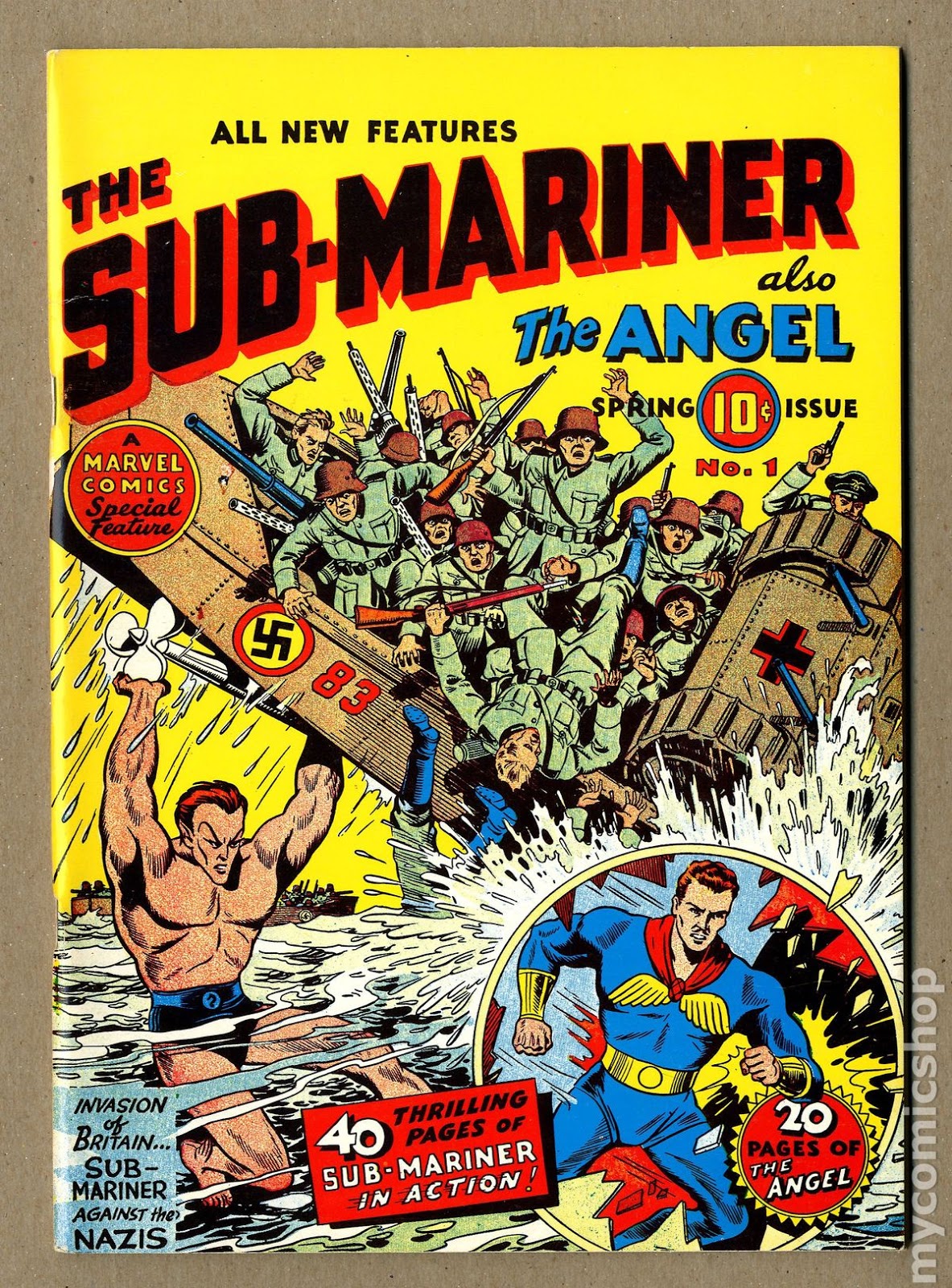
Flashback 19: Sub-Mariner Comics 1 (1941/1974)

The 19th issue of the Flashback reprint series presents SUB-MARINER COMICS # 1 originally published in 1941 by Timely/Marvel. Two Sub-Mariner stories by Bill Everett. Angel back-up story by Paul Gustavson. Alex Schomburg cover. 68-pages, full color cardstock covers, 7-3/4-in. x 10-3/8-in. black-and-white interior on white paper stock, saddle-stitched binding.

Flashback 01: Daredevil Battles Hitler #1 (1941/1970)

The first issue of the Flashback reprint series presents Daredevil Battles Hitler # 1 originally published in 1941 by Lev Gleason. Features Daredevil, the Claw & others. 68-pages, full color cardstock covers, 7-3/4-in. x 10-3/8-in. black-and-white interior on white paper stock, saddle-stitched binding.

FF (2011 Marvel) 1G CGC 9.2

Limited Gatefold Variant Cover by MARKO DJURDJEVIC Written by JONATHAN HICKMAN Pencils by STEVE EPTING It's the FANTASTIC first issue of FF! A bold new direction for Marvel's First Family featuring new members, old friends, older enemies and uneasy alliances that will send shockwaves through the Marvel Universe. With stunning art work by Steve Epting and Paul Mounts, please join writer, Jonathan Hickman, on the second massive arc in the bold new direction for the 'World's Greatest Comic Magazine.' 40 PGS./Rated A

Available@http://www.mycomicshop.com/

Avengers Arena #1

MARVEL COMICS
Release Date: 12/12/12
Avengers Arena #1
YOUNG BABY VARIANT

New, Unread, NM or Better Condition Bagged & Boarded (W) Dennis Hopeless (A) Kev Walker (CA) Skottie Young Trapped on an isolated island, 16 superhuman young adults (including cult faves like members of the Runaways, The Avengers Academy and Darkhawk) are given a chilling ultimatum by their demented captor: Fight or die...only one will walk out alive! Thus begins a primal battle that will test the skills, stamina and morals of each combatant. Welcome to Murder World, where the secrets are plenty, alliances are fleeting, and the key to victory might be rewriting the rules of the game. Who will survive? The rising star team of Dennis Hopeless (X-MEN: SEASON ONE) and Kev Walker (THUNDERBOLTS) dare you to tune in to your new favorite comic NOW!
Available@ http://www.horizon-comics.com/

Before Watchmen: Dr. Manhattan #3

Fans of the character get more insight into the world's most powerful and complicated man.

The Good

A lot of the concepts and themes that were present on the surface of this series in previous issues are explored in greater length here. The extent of Dr. Manhattan's powers, for example, is one of those issues. What can he do, exactly? When he changes the outcome of an event, does that mean that he simply changed the future, or did he unintentionally create a new timeline where a new possibility exists? Meanwhile the old possibility still exists, as well? One thing is for sure, if anyone can write existentialism and integrate head-scratching concepts like whether or not time is relative to life/a story; it's J. Michael Straczynski. If you aren't used to reading stories that deal with past present and future, and that define time and space, Straczynski provides a story that touches on those concepts and explains them in a simplified way. That's certainly one of the things I enjoyed about this issue.


However it isn't the story that is guaranteed to blow you away so much as the art. The art in this comic is absolutely jaw-dropping. Reading this issue is a process. Each page of this comic is more detailed than last, and helps to tell the story in an incredible way. Hughes' work is so abstract and different; the way he illustrates each panel is so brilliant that you will be drawn into this gorgeous comic for his skill alone. It's like seeing a Norman Rockwell painting come to life, that's how beautiful it is.
The Bad

I think the purpose of these BEFORE WATCHMEN titles is to add some depth or dimension to characters that we met in Moore's WATCHMEN title. I would think the purpose is to find how these characters are grounded and what drives them. Although we have one issue left to go, it doesn't really feel like Straczynski humanizes Dr. Manhattan in his series, which is something I had expected him to do. Unlike other heroes in WATCHMEN, Manhattan undergoes a change that takes him from being a human male with an ordinary life, to a super-powered being who is completely detached from society.
The Verdict

This issue features a lot of flashbacks that gives readers a closer look at Dr. Manhattan's life before he became Dr. Manhattan. We see him as a child and become acquainted with his father. Straczynski also goes on to explore that particular relationship. I think the only problem with this is the fact that it doesn't quite tell us who the character is. What was his personality like? Was he a moral person? How did he meet his first wife? There's just a ton that we don't know about Dr. Manhattan even after having read the three issues of his BEFORE WATCHMEN mini-series. So, at the end of the day, who is he exactly? What was the purpose of this series? Still, beyond all that, the issue itself is very well written, well organized and Straczynski certainly plays to Hughes' strengths. Hughes knocks the art in this issue out of the park completely, delivering a just absolutely stunning piece of work

History of Mandrake -The Magician

Mandrake the Magician

Mandrake the Magician is a syndicated newspaper comic strip, created by Lee Falk (The Phantom), which began June 11, 1934. Phil Davis soon took over as the strip’s illustrator, while Falk continued to script. The strip was distributed by King Features Syndicate.

Davis worked on the strip until his death in 1964, when Falk recruited current artist Fred Fredericks. With Falk’s death in 1999, Fredericks became both writer and artist.

Characters and story

Mandrake is a magician whose work is based on an unusually fast hypnotic technique. As noted in captions, when Mandrake “gestures hypnotically”, his subjects see illusions, and Mandrake used this technique in his battles with a variety of gangsters, mad scientists, extraterrestrials and characters from other dimensions.

Mandrake and the Phantom Magician in Mel Graff’s The Adventures of Patsy are regarded by comics historians as the first superheroes of comics. Comic’s historian Don Markstein writes, “Depending on how you define the term, Patsy’s recurring rescuer, The Phantom Magician, may have been the first superhero in comics… Some people say Mandrake the Magician, who started in 1934, was comics’ first superhero.”

Supporting characters

Lothar is Mandrake’s best friend and crime-fighting companion. Mandrake first met Lothar during his travels in Africa. Lothar was then “Prince of the Seven Nations”, a mighty federation of jungle tribes. He passed on the chance to become king and instead followed Mandrake on his world travels, fighting crime and villains from all over the world (and the rest of the universe as well). Lothar is often referred to as the strongest man in the world with the exception of perhaps Hojo — Mandrake’s chef and secret chief of Inter Intel.

One of the first black crime fighting heroes ever to appear in comics, Lothar made his first appearance alongside Mandrake in 1934 in the inaugural daily strip. Mandrake and Lothar are generally recognized as the world’s first interracial team of crime fighters.

In the beginning, Lothar was little more than Mandrake’s servant. He spoke poor English, wore a fez, short pants and a leopard skin. His muscles far exceeded his mental abilities. When artist Fred Fredericks took over in 1965 (after original artist Phil Davis had died), Lothar was modernized; he began to speak correct English, and his clothing changed, although he still often wears shirts with leopard-skin patterns.

Narda is of royal blood; she is Princess of the European nation Cockaigne (today ruled by her brother Segrid). She made her first appearance in the second Mandrake story. Although she and Mandrake were infatuated with one another from first sight, they didn’t marry until 1997, when it was an extravagant triple wedding ceremony– at Mandrake’s home of Xanadu, Narda’s home country Cockaigne and Mandrake’s father Theron’s College of Magic (Collegium Magikos) in the Himalayas.

Theron is Mandrake’s father, although this was a secret to Mandrake for a long time. Mandrake’s mother died shortly after she gave birth to Mandrake and his twin brother Derek. Theron is the headmaster of the College of Magic (Collegium Magikos) somewhere in the Himalayas. Theron is hundreds of years old, probably due to the energy of the powerful Mind Crystal of which he is the guardian.

Hojo is Mandrake’s chef at his home of Xanadu. However, he is also the secret Chief of the international crime fighting organization Inter-Intel, in addition to being a superb martial arts expert. As such, he has used Mandrake’s help with many cases. Hojo’s assistant at Inter-Intel is Jed.

The Police Chief is named Bradley but mostly just called “Chief” and has been aided by Mandrake on several occasions. He created the “S.S.D.” (Silly Stuff Dept.) for absurd and unbelievable cases that only Mandrake could solve. He has a son, Chris.

Magnon is Mandrake’s most powerful friend. He is the emperor of a million planets, but even he has sometimes needed Mandrake’s help. Magnon and his wife Carola have a daughter, Nardraka, who is named after Mandrake and Narda and is their godchild.

Lenore is Mandrake’s younger half-sister. She is a world-renowned explorer.

Karma is Lothar’s girlfriend, an African princess, who works as a model.

Xanadu, Mandrake’s high-tech residence, has one of the world’s best security with all electronic gadgets like closed circuit TV, sectional road which divides from half, dropping iron gates.

William E. Blake Collection of True Life 1940s Era Comics

Essay: A View of History: True Comics, 1941-1945 | Blake Collection Inventory Listing
Dr. William E. Blake, Professor Emeritus of VCU's History Department, donated his collection of 1940s true life comics to Special Collections and Archives in 2001. The collection includes over 300 rare comic books and memorabilia from the Golden Age of comic book publishing. This site includes a listing of the comic books in the collection, an article about true life comics written by Dr. Blake, and numerous images of items from this rare and important collection.

The Blake Collection of True Life Comics is part of Special Collections and Archives' Comics Arts Collection -- which includes an extensive collection of reference periodicals and books about the art and history of comic strips, comic books, and related subjects; over 30,000 comic books dating primarily from the 1960s through today; the papers and drawings of two Richmond newspaper political cartoonists, and several other manuscript collections. For more information about these collections, please email Special Collections and Archives.
The 1940s are considered the Golden Age of comic books. What started out as selling reprinted Sunday comic strips, became a new field of publishing in the 1930s as original comics became the standard. Superhero comics became all the rage after the 1938 introduction of Superman inAction Comics and the 1939 appearance of Batman in Detective Comics. By 1941, superhero titles had inundated the comic book market.
When the editors at Parent's Magazine noticed the proliferation of comic titles, they decided it was time to publish something educational. The United States participation in World War II was looming in the very near future and a cultural shift towards patriotism was taking place. True Comics, according its publisher, was a comic book and a newspaper combined. It hit the newsstands in early 1941. It featured stories about historical events, scientific discoveries, and heroic individuals. The first run of 300,000 copies sold out within two weeks and returned to press for a second run. It remained a popular title for a number of years until it folded in 1950. The collection includes issues #1 - 65 spanning from April 1941 to October 1947.
Index to True Life Comics -- Maintained by Michigan State University Libraries: Special Collections Division.
In April 1980, Dr. Blake presented a paper on the history of "true life" comics,"A View of History: True Comics, 1941 - 1945", to the Popular Culture Association in Detroit, Michigan. It discusses the impact of True Comics during the war years.
Inspired by the success of True Comics, Better Publications rushed to press Real Life Comics in the fall of 1941. It was another factual and history comic book anthology. It enjoyed an immediate success that last for the next eleven years. A companion true adventure comic, It Really Happened, was published in 1944. The collection includes issues #1 - 40 covering September 1941 until July 1947 of Real Life Comics and issues #2 - 4 dated 1944 of It Really Happened.
True Comics and Real Life Comics are just two titles of true life comics that can be found in Dr. Blake's collection. The collection also includes educational, war, and other titles. Additional true life comic titles include Real HeroesSports StarsPicture News, and Real Fact Comics. Educational comic titles include Science ComicsPicture Stories from American HistoryClassic ComicsClassics Illustrated, and Famous Stories. A few of the numerous war comic titles include War HeroesUnited States MarinesNavy HeroesFlying Cadet, and American Air Force. Other titles include The1946 Comics CalendarNew York World's Fair ComicsRailroads Deliver the Goods, and Rails Across America. There are even a few superhero titles.
Visit this complete listing of the Blake Collection of True Life Comics.
In addition to the comic book collection, Dr. Blake donated several pieces of personal comic book related items. Items of note include a Little Orphan Annie Decoder Pin (made famous by the film "A Christmas Story") that is dated 1935. The items from the Supermen of America Club include a certificate,decoder, and pin circa 1939. The Junior Justice Society of America items are dated 1942 and include a badge, circular decoder, andcertificate.
Dr. William E. Blake, a professor of history at VCU from 1965 through 1992, was born in 1930 in Richmond, Virginia where he began collecting comic books as a young teenager. His interest in history and current events led him to concentrate his comic book collection on "true life" comics. He received a B.A. from the University of Cincinnati (1956), a M.A. from Cincinnati Christian College (1957), a B.D. from Cincinnati Christian Seminary (1958) and a Th.M (1962) and a Ph.D (1968), both from Union Theological Seminary in Virginia. He began his affiliation with VCU in 1965 as a professor of history at Richmond Professional Institute (which merged with MCV to become VCU in 1968). He served twice as Chairman of the VCU Department of History and Geography. He also helped organize the VCU Faculty Senate and the Virginia Faculty Senate, serving as the first president of both of these organizations. Dr. Blake retired as a Professor Emeritus in 1992 although he has continued to teach classes.